
Phase I Calibration Findings
During NIH-funded Phase I research, Liquen Technologies demonstrated the feasibility of a compact, portable calibration system using supercritical CO₂ cartridges and dynamic dilution. Our findings support accurate delivery of trace gases and semi-volatile compounds, advancing reliable on-site calibration without bulky compressed-gas cylinders.
Gas Calibration
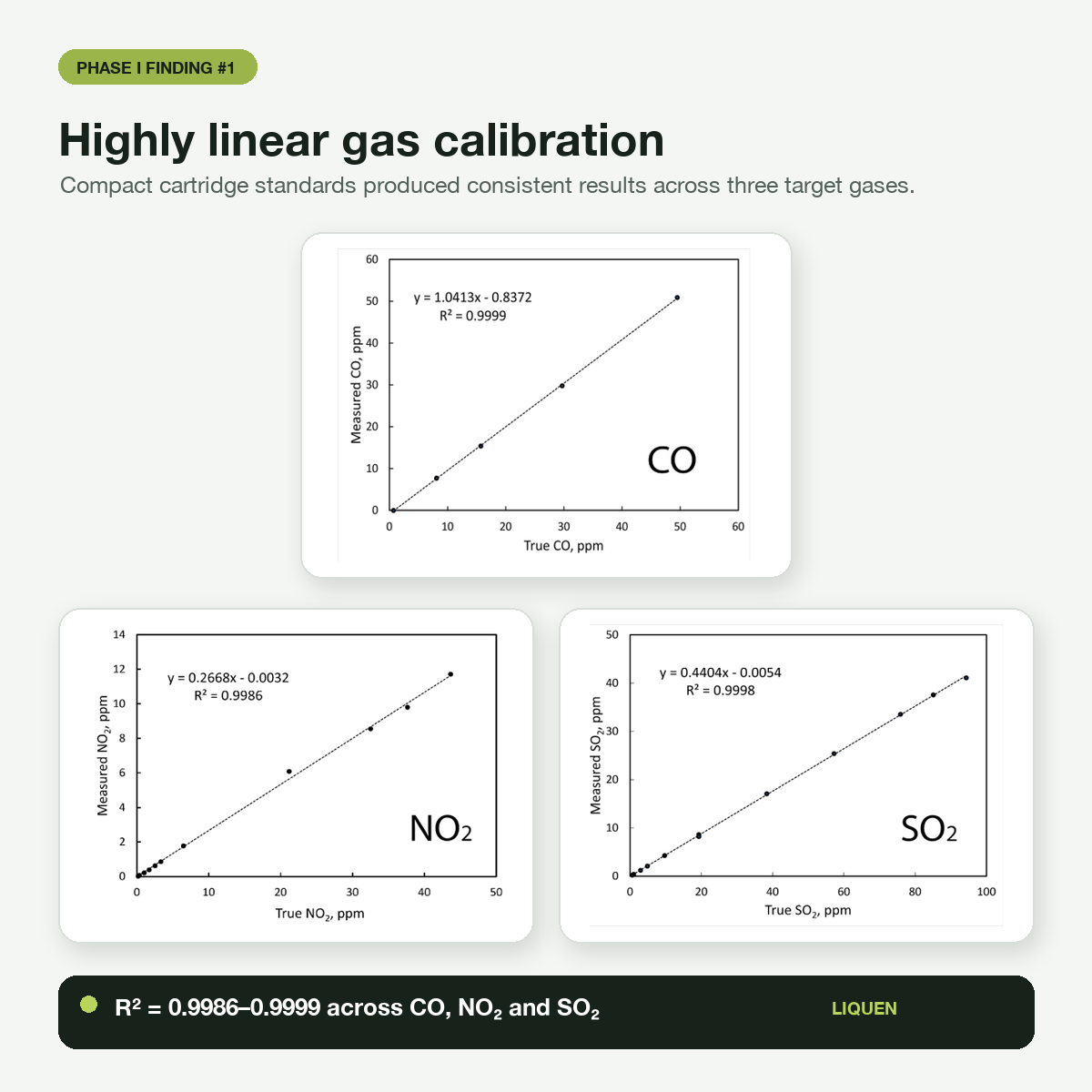
Calibration results for carbon monoxide, nitrogen dioxide and sulfur dioxide were highly linear, with coefficients of determination of 0.999 or greater.
Cartridge-based BTEX standards closely matched a conventional compressed-gas reference. Calibration-slope ratios were 1.01 for benzene, 1.02 for toluene and 1.04 for ethylbenzene and xylenes.
The carrier fluids produced no significant sensor response or change in sensitivity at the tested dilution levels.

Particles
Our early particle testing produced a steady flow of calibration particles and identified the improvements needed to make future measurements more precise and repeatable.
PFAS
Verifying PFAS destruction where treatment occurs.
PFAS treatment teams still rely heavily on costly, laboratory-based standards and time-consuming sample analysis. Emerging portable instruments can also drift and often require frequent calibration. Liquen’s goal is to provide compact, traceable gas-phase standards that help verify analytical instruments before and during PFAS destruction trials